You’re Not “Just Tired”… This Is Quiet Burnout

Watch the video
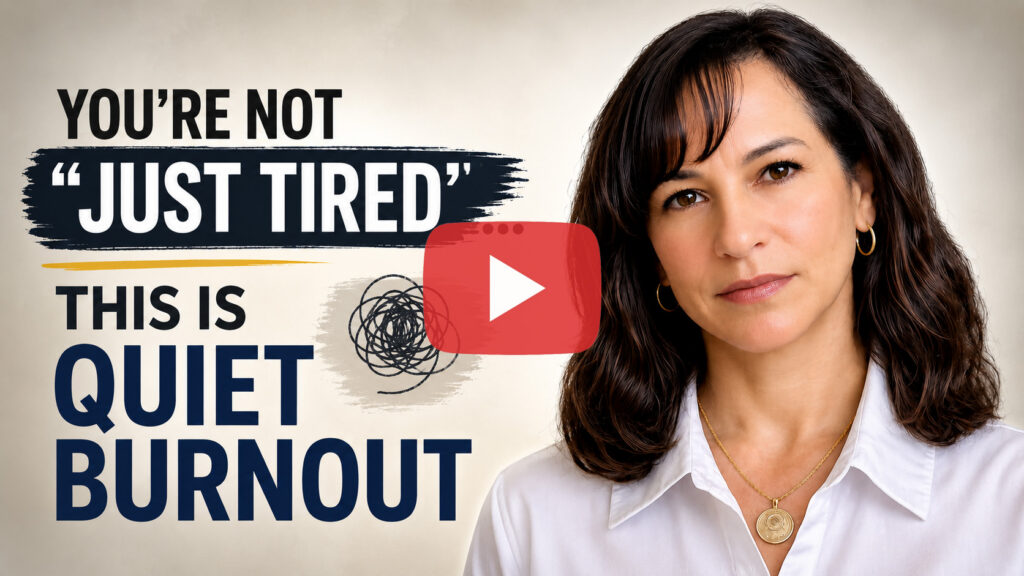
You wake up, immediately check your phone, and start moving through your day—work, family, responsibilities—and somehow, before the day has even really begun, you already feel behind. By the time you get a moment to pause, you’re exhausted… but nothing obvious has gone wrong.
This is where a lot of people get confused, because burnout doesn’t always look dramatic. It doesn’t always show up as a breakdown or a big moment where everything stops. Sometimes, it’s much quieter than that.
This is called quiet burnout—the slow, invisible drain that happens when life is asking more from you than your energy can sustain.
One of the simplest ways to understand this is through a typical day. Before you even get out of bed, you’re already thinking about who needs you today—your parents, your partner, your kids, your work… everything waiting for you. You grab your phone and start to scroll while sipping your coffee, but there’s already a tightness in your chest. You move through your day checking things off, doing what needs to be done. From the outside, everything looks fine. But internally, something feels off.
You’re tired, even after sleeping. You’re less interested in things you used to enjoy. You’re making small mistakes, forgetting things, and feeling a little more irritable than usual. And maybe most telling, you feel disconnected—from yourself, from other people, from your life.
This is what makes quiet burnout so easy to miss: you’re still functioning. You’re still showing up. You’re still “handling it.” But your system is running on depleted energy.
For most people, this doesn’t happen because of one big event. It’s the accumulation. High expectations—career, family, social life, maybe even side projects. We live in a culture that reinforces the idea that doing more is better, that being busy means you’re doing something right. Usually, the first thing that gets sacrificed is you.
Sleep gets shortened. Meals get rushed. Downtime disappears. Stress doesn’t stay in one category, either. Emotional stress, physical stress, financial pressure—they stack. Even if each one seems manageable on its own, together they create a constant, low-level strain on your system, and over time, that strain shows up.
On the surface, it can look like anxiety, difficulty focusing, irritability, or fatigue. But underneath that, your body is staying in a constant stress response.
Sleep becomes less restorative. Recovery slows. Your immune system weakens, opening the door to illness and symptoms that linger longer than they should. This isn’t just mental or emotional. It’s physical. Your system is being worn down over time. Emotionally, there’s also that subtle detachment—like you’re going through the motions instead of actually being present in your life.
The good news is that you don’t need a complete life overhaul to begin shifting this. In fact, trying to overhaul everything usually adds more pressure. What actually works is small, consistent adjustments: taking short breaks during the day, even a few minutes to reset; creating space where there is no task or output required; prioritizing sleep, even a slight increase; pausing to slow your breathing and calm your nervous system; and learning to say no—or delegate—without attaching guilt to it.
Because protecting your energy is not selfish. It’s necessary.
When you’re worn down, you can’t show up the way you want to—for yourself or the people who need you. So instead of trying to fix everything at once, start by interrupting the cycle in small ways. Simplify what you can. Create clarity where there’s mental clutter. Take small steps that reduce pressure instead of adding to it.
And this is where awareness becomes important—not judgment, just awareness.
Where is your energy being drained right now? Where are you carrying the heaviest load? What signs are showing up for you—fatigue, irritability, disconnection? And what is one small thing you can shift this week?
Not ten things. One this week… and one next week.
If this resonates with you, I encourage you to keep exploring this conversation. Stress and fatigue are often symptoms of deeper patterns involving the body, the mind, and subconscious beliefs. When you begin to understand those patterns, you can start making changes that create real shifts in how you feel.
If you’d like to go deeper into how stress, patterns, and subconscious beliefs influence your health and energy, I explore that in my book, Why You’re Sick and How to Get Well. And if you’re ready for a more personalized approach, you can schedule a discovery session with me to look at what may be driving your patterns—and where you can begin shifting them.
Start small. Pay attention to your energy. And give your system the space it’s been asking for.